Status update — June 2026: Starlink is now officially licensed in Uganda. The operational licence was signed on 15 May 2026 at State House Entebbe, witnessed by President Museveni. Commercial service is rolling out during 2026, with the licence requiring a local gateway, a physical presence in Uganda, and registration of all devices. In short: the legal path is now open, and the service is preparing to go live.
Here's something most people in Western Uganda already know from experience: the further you get from town, the worse the internet gets. First the signal weakens. Then it starts dropping. Eventually it just isn't there at all. Schools, farms, lodges, clinics — plenty of them sit in places fibre was never going to reach and the mobile towers never really covered.
That's finally starting to change. Starlink's satellite internet is now licensed to operate in Uganda, and preparing to begin commercial service. And for a part of the country the cables and towers skipped over, that's a bigger deal than it might sound.
So let's walk through it properly. What Starlink actually is, how it works, who should bother with it, what nobody tells you about running one, and how to get connected if you're out west. No sales pitch dressed up as advice — just the real picture.
What is Starlink, and how does it actually work?
Most internet in Uganda travels along the ground. Fibre cables buried beside the roads, and signals hopping between mobile towers. Where that infrastructure exists, it works. Where it doesn't, you're stuck — and laying cable or putting up a tower in a far-off trading centre is expensive and slow, so often it just never happens.
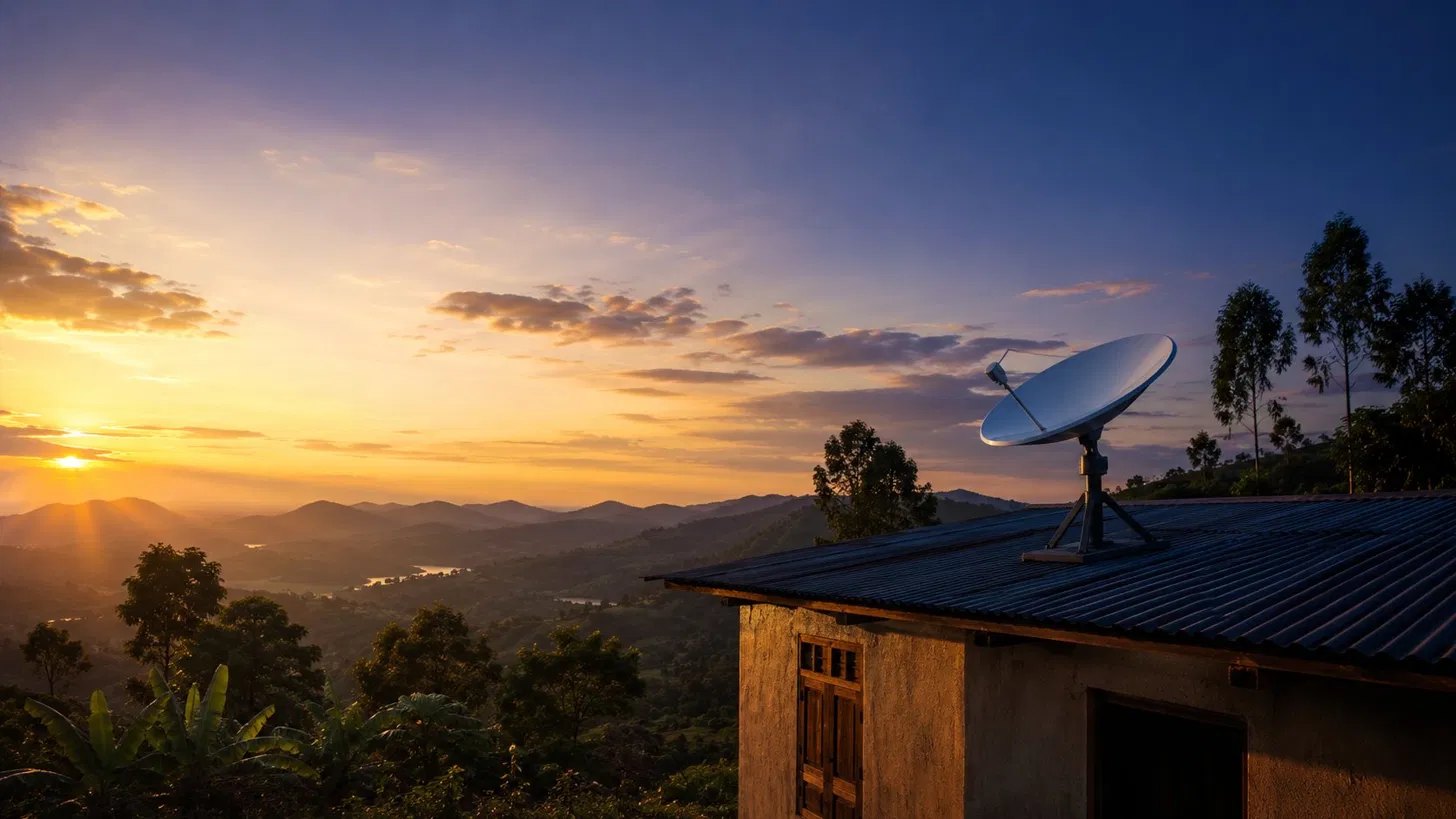
Starlink skips the ground entirely. It uses a web of satellites flying in low orbit — much closer to Earth than the old satellite systems people remember being slow and clunky — and beams the internet straight down to a small dish at your place. The dish locks onto the satellites passing overhead, and that's your connection. It doesn't care whether there's a tower nearby. There doesn't need to be one at all.
What that means in plain terms: a fast, steady connection is now possible in spots that have genuinely never had one. That's the whole reason this matters.
Starlink vs mobile data and fibre: an honest comparison
If you're already on MTN, Airtel, or a fibre line, the question isn't really "which is best." It's "which one suits where I am and what I'm doing." They all have a place. Here's the fair version.
Mobile data (MTN, Airtel) is the easiest to get and it does the job in and around the bigger towns. The problem is that it lives and dies by the tower — how close you are to one, and how many other people are leaning on it at the same time. Out in the rural west that usually means a signal that fades as you drive, grinds to nothing at peak hours, and just vanishes behind the hills. Grand for checking your phone near town. Not something you'd want to run a whole school or business on.
Fibre is brilliant when you can actually get it — fast, steady, reliable. But that "when you can get it" is the catch. Fibre is costly and slow to roll out, so it sticks close to the main towns and roads. For a lodge or a farm sitting well outside that, the honest answer is that fibre probably isn't coming for years, if ever.
Starlink flips the whole thing, because it doesn't lean on any local cable or tower. The connection comes from satellites overhead, which is exactly why it holds up in the remote places where mobile and fibre give up. It's usually not the cheapest option going, and in a town already wrapped in good fibre it can be overkill. But when the problem is coverage rather than money? Out there, not much else competes.
A rough way to decide:
- Sitting in a town with decent fibre or strong mobile signal? What you've got might be serving you fine already — keep Starlink in mind as a backup for when it drops.
- Out past reliable coverage — a rural school, a farm, a lodge, a trading centre? This is Starlink's home ground. It works where the others can't reach, full stop.
- Running something that can't afford to go dark? Loads of shops, clinics, and forex bureaus just bolt Starlink on as a second line that kicks in the second the main one fails. No need to tear anything out.
Nobody's saying Starlink beats everything. The point is it fills the gap the others leave behind — and in Western Uganda, that gap is wide.
Is Starlink legal in Uganda?
Yes. The operational licence was signed on 15 May 2026 with the Uganda Communications Commission (UCC), at State House Entebbe and witnessed by President Museveni. That's a real milestone — but it's worth being precise about what it means right now.
Being licensed is the green light for the service to roll out; it doesn't mean every kit is on a shelf today. Commercial service is coming online through 2026, and the licence carries firm conditions: a local gateway, a physical presence in Uganda, and registration of every device used in the country. Earlier, terminals that had slipped in were activated abroad and carried over the border — which is exactly why they got switched off. The lesson is simple: once service is live, the right way in is genuine, properly registered equipment through legitimate channels, set up and supported locally — not a mystery kit of unknown origin. Doing it properly protects your money and keeps you clear of trouble.
This is exactly where a local team earns its keep. At Tibz Tech, we supply, install, and support genuine Starlink equipment — so you actually know what you're buying, it gets set up right, and there's somebody here in Uganda to ring when something needs sorting.
Who is Starlink right for in Western Uganda?
It's not for everyone, and pretending otherwise would be doing you a disservice. Here's where it genuinely makes sense out west.
Schools
This is probably the clearest case of the lot. One connection and a school suddenly has online learning, research, digital-skills training — the stuff students are going to need for the rest of their lives. The sticking point is almost always the upfront cost, which is why the funding side (PTA contributions, alumni and diaspora sponsorship, NGO and CSR support) ends up mattering just as much as the dish itself.
Farms, agribusiness, and rural enterprises
Coffee and tea cooperatives, processing sites, farms — more and more of them run on a connection now. Mobile money, market prices, records, payments. When the mobile data keeps letting you down, steady internet stops being a nice-to-have and starts being part of the job.
Tourism and hospitality
The lodges, camps, and hotels around the western parks — Queen Elizabeth, Bwindi, Rwenzori, Kibale — need to give guests WiFi that actually works, and they've usually got the budget to make it happen. For them, the internet is part of what the guest is paying for.
Health centres and NGOs
Places working where fibre and mobile simply don't hold up care a lot about a connection that just works. Records, coordination, telemedicine — for all of it, reliability is the whole ballgame.
Households, trading centres, and remote workers
For families and small trading centres where buying a full private kit is out of reach, shared community WiFi makes it affordable. And for the remote workers, students, and content creators who need solid upload and download speeds, a stable connection can be the difference between working from home and not working at all.
What does it really take to run Starlink?
This is the bit people tend to skip over until after they've paid — so let's get to it first.
Power. Electricity in the west can be hit and miss, and the terminal needs power to do anything. Pairing it with solar and a battery keeps you online through the outages, and running entirely off-grid where there's no mains at all. For a lot of western setups, solar-plus-Starlink isn't really an extra — it's the thing that makes the connection genuinely dependable.
Installation. The dish needs a clear shot at the sky, a proper mount, the right alignment, and cabling that'll survive the weather. Stick it in a bad spot and it'll underperform — simple as that. Professional installation isn't us trying to pad the bill; it's the line between a connection that holds up in any weather and one that drives you mad.
Ongoing support. Now and then the kit needs a tweak, and the subscription needs looking after. Having someone local who can actually come out, sort the problem, and keep it running is what turns a one-off purchase into something you can rely on for years.
On prices and exact speeds — those move around, so we're not going to print numbers in a guide that's meant to stay useful next year. For what it costs today, and what to realistically expect at your specific spot, honestly just ask us.
How to get connected with Tibz Tech
Tibz Tech is a Ugandan technology and connectivity company working across Western Uganda and beyond. We're not some faceless website shipping you a box — we're a local team that supplies, installs, and supports genuine Starlink equipment in person.
We cover the western districts and the rural areas around them — Mbarara, Fort Portal, Kasese, Bushenyi and Ishaka, Hoima, Kabale, Rukungiri, Ntungamo — plus the tourism stretch around Queen Elizabeth, Bwindi, Rwenzori, and Kibale. If you're in or near any of those, you're within reach.
How it usually goes:
- Check your location first. Tell us where you are and we'll tell you straight whether Starlink's a good fit for your site — before you spend a shilling.
- Get a quote that fits. Home, school, farm, lodge, business — we'll work out the right setup, solar backup included where the power's unreliable.
- Proper installation. Mounting, alignment, cabling, registration, the lot — done so it works from day one.
- Local support after. Something playing up? There's a team here in Uganda to call.
For schools and community projects, we'll also help put together connection bundles alongside the funding routes — because a good connection shouldn't fall over at the first hurdle of an upfront cost.
Bringing fast internet where the towers can't reach
For too long, being far from town meant being far from everything else too. Satellite internet quietly takes that barrier away — and for Western Uganda, that opens up real possibilities for the schools, businesses, and families the ground infrastructure left behind.
If you've been wondering whether decent internet is finally within reach where you are, the honest answer is: it might well be. Easiest way to find out is to ask.
Not sure Starlink will work at your place? Get in touch — we'll give you the honest answer, and help you get connected the right way.